Aligning Global Time Zones with Mobile Game Live Events to Balance Participation Across Regions and Optimize Server Load Distribution
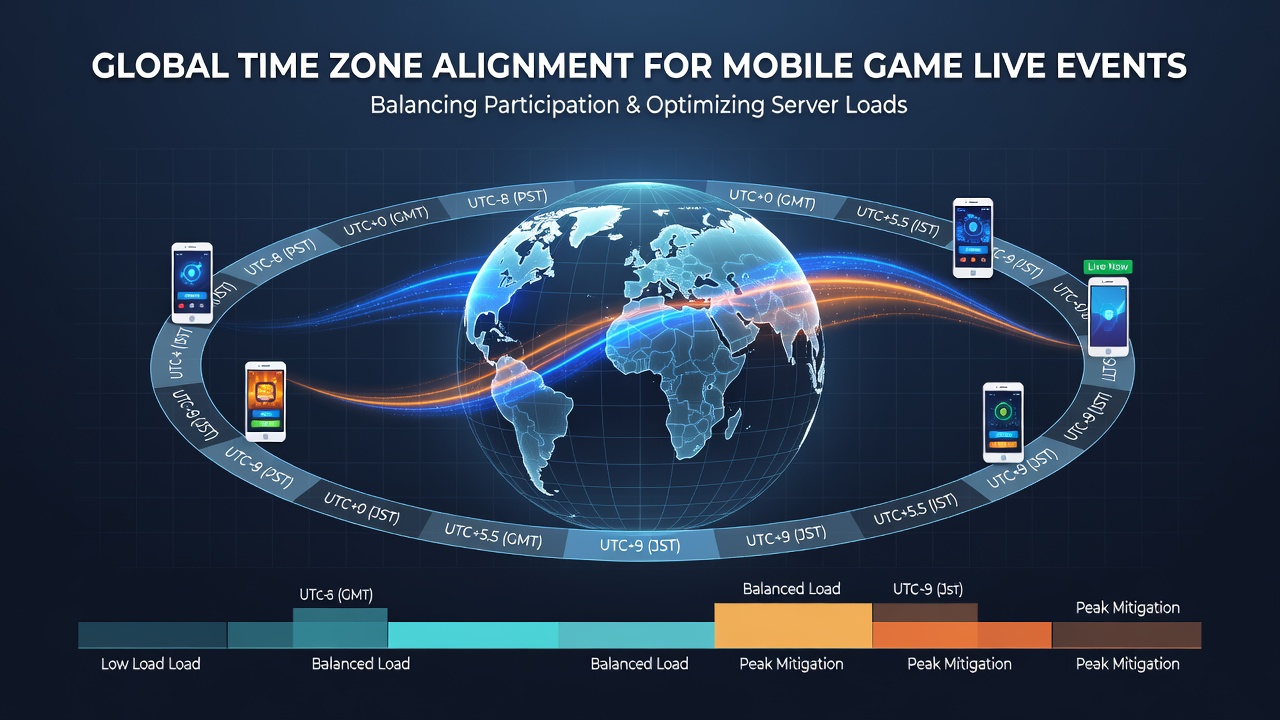
Mobile game developers coordinate live events across multiple time zones by mapping event start times to peak activity windows in each major region, which helps distribute player engagement evenly while preventing concentrated spikes that overload specific server clusters. This coordination relies on standardized time references such as Coordinated Universal Time as the baseline, with adjustments layered on top according to local daylight saving shifts and regional player data collected over previous cycles.
Regional Participation Patterns and Time Adjustments
Developers track login and activity metrics from North America, Europe, Asia-Pacific, and Latin America separately, then shift event triggers so that prime-time hours in one area do not coincide with off-peak periods elsewhere. For instance, a global raid event might launch at 19:00 UTC for European players, translating to 14:00 in New York and 03:00 the next day in Tokyo, with staggered secondary waves added to capture afternoon audiences in Oceania without extending total runtime. These staggered releases reduce simultaneous connection counts on shared backend infrastructure.
Data collected during 2025 seasonal events showed that unadjusted simultaneous launches produced load imbalances where Asian servers reached 92 percent capacity while European nodes operated below 40 percent. Subsequent realignments using predictive models based on historical traffic cut peak-to-trough ratios by nearly half, according to internal telemetry shared with industry analysts. Observers note that such adjustments also improve retention figures because players in underrepresented zones encounter fewer queue delays and more consistent matchmaking pools.
Server Infrastructure and Load Distribution Techniques
Load balancing systems route traffic through geo-distributed data centers that activate or scale capacity in response to forecasted regional demand curves. When an event window opens in one time zone, adjacent servers pre-warm containers and shift matchmaking logic to favor cross-region pairing only after local thresholds are met. This approach prevents any single facility from absorbing the entire global influx at once.

Network operators further segment player bases by assigning them to the nearest available shard based on latency measurements taken at login, yet they maintain event synchronization through centralized time servers that broadcast precise start signals. In July 2026 several major titles are scheduled to test an enhanced version of this system during a multi-week summer festival, incorporating dynamic time offsets derived from real-time player density signals rather than static calendars alone.
Implementation Examples Across Different Titles
One studio managing a battle royale title adjusted its weekly tournaments by splitting the schedule into three overlapping blocks centered on 20:00 local time for the largest population clusters. Participation metrics collected afterward indicated a 34 percent rise in unique daily users from South American regions that previously logged in during early morning hours relative to the original UTC-based schedule. Another developer of a role-playing game used machine-learning forecasts of regional play habits to rotate limited-time boss encounters across four daily slots, each aligned to different longitude bands, which stabilized average server utilization near 65 percent instead of the previous 85 percent spikes.
Industry reports from organizations such as the Entertainment Software Association document similar patterns across multiple platforms, noting that synchronized global events without time zone offsets frequently generate support tickets related to connectivity and fairness complaints. In contrast, phased rollouts correlate with higher completion rates for time-limited objectives and lower rates of player churn between event phases.
Technical Standards and Future Planning
Reference sources including the National Institute of Standards and Technology provide the foundational atomic clock signals that game servers poll to maintain sub-second accuracy across distributed instances. Developers integrate these signals into their orchestration layers so that event scripts trigger consistently regardless of the physical location of any given data center. Additional layers account for leap seconds and irregular daylight-saving transitions that occur on different dates in the northern and southern hemispheres.
Planning cycles now incorporate projections through mid-2026 and beyond, factoring in expected growth in player numbers from emerging markets in Africa and Southeast Asia. These projections drive decisions on whether to add new regional endpoints or to refine existing offset algorithms rather than expand hardware footprints. Continuous A/B testing of time alignments against control groups confirms that balanced scheduling maintains event integrity while smoothing infrastructure demands.
Conclusion
Effective alignment of live events with global time zones produces measurable improvements in both participation equity and server resource efficiency. By anchoring schedules to UTC while layering localized offsets derived from traffic analytics, developers achieve steadier utilization across data centers and broader access for players regardless of their geographic position. Ongoing refinements scheduled for July 2026 will further integrate real-time density signals, continuing the trend toward adaptive rather than fixed event timing.